Table of Contents
General Race Info
Current Duty Roster
Sign On Procedures
Race Course & Start Flag Sequence
Skippers – need crew?
Sailors – need a boat to crew on?
Club Boats
Beginners / Non-members
Race Series Competitions
Spectators
Facilities + Food & Drink Options
Sailing to Win
General Race Info
- Any changes will be sent out the week before by email.
- Location – TVSC Container, Fingal Head Boat Harbour.
- Race Briefing – 12.00 (NSW) or 1 hour before first race start. Attendance is compulsory for all sailors and support team.
- Usually TWO races per day.
- First Race Start time – not before 1.00pm (NSW).
- Second Race Start – ASAP after First Race.
- Each race duration approx. 35 mins to 1 hour.
- Time Limit for these shorter races is 1 hour 20 minutes.
- All races to be sailed under RRS rules, except as modified at Briefing.
- Race penalties: 1 penalty turn for touching mark, 2 penalty turn for ‘minor’ infringement, DSQ and retirement for ‘major’ infringement.
- All boats are required to have third party insurance.
- Event Registration is always here.
Please note the following waiver:
I acknowledge that my participation in TVSC activities is at my own risk and I hereby release TVSC, it’s members officers, servants and agents from any and all claims, costs, and demands whatsoever and howsoever arising from my participation.
Except where provided or required by Law and it cannot be excluded, I agree that TVSC is absolved from all liability for any injury to me (whether fatal or otherwise) or any damage to my property (except for willful damage) resulting from my participation in any TVSC activity.
In consideration of TVSC accepting this application, I (a) release and forever discharge TVSC from all claims that I may have or may have had but for this release arising from or in connection with my participation in any TVSC activity; and (b) indemnify and hold harmless TVSC to the extent permitted by law in respect of any claim by any person against TVSC or any members officers, servants or agents acting for TVSC arising as a result of or in connection with my participation in any TVSC activity whilst I am participating or at any time thereafter.
Current Duty Roster – Winter 2026
The club is run voluntarily by its members, who support their club in many different ways. If you would like to be part of the club, please consider getting involved in a support role – training is given.
Safety boat drivers just require a power boat licence. A knowledge of sailing is a bonus but is not essential.
Current Duty Roster here
Note to sailors – if you sign up in advance for an onshore or safety boat duty you still get points towards the Club Pointscore Series (average points for the
series).
Sign On Procedures
Skippers sign on & pay $5 per boat race fee – before rigging your boat.
Check you sail number is correct on the sign on sheet & note if you have a different number on your spinnaker.
Crew names must be in full and legible.
Non-members sailing for the first time must complete an indemnity form and Sail Pass at the sign on desk. This is only required once and covers you to sail 3 times with the club before membership is required.
Skippers to Sign off after the race.
Race Courses
The section of the Tweed River and positions of course marks and fixed marks for most club races are shown below – start direction depends on the wind direction. Races always start into the wind.
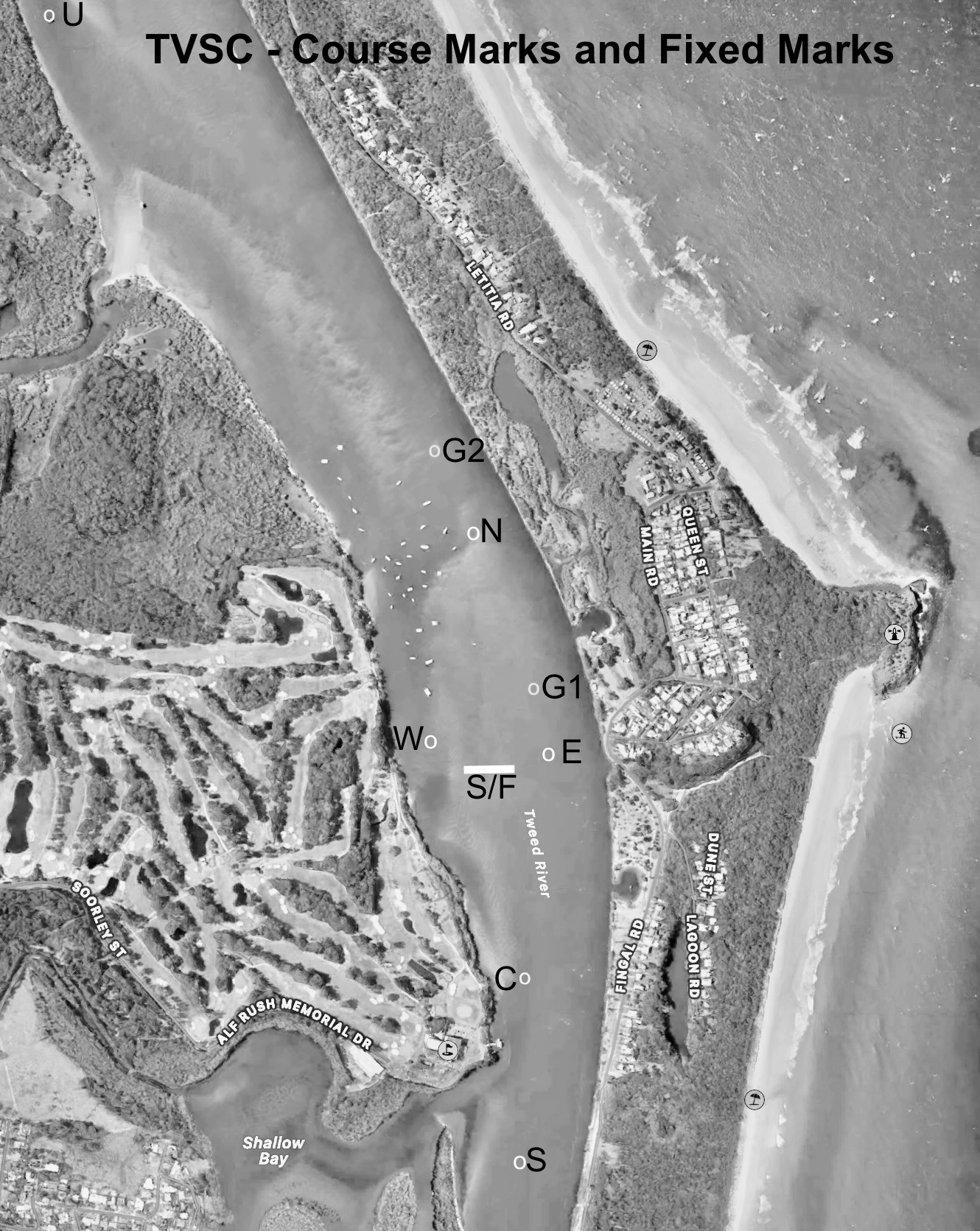
- The positions of all Course and Fixed Marks shown above are approximate.
- U – Southernmost Special (yellow) bouy near Ukerebagh Island
- G1, G2 – Green Channel Lateral Markers
- C – East Cardinal Marker
- N,S,E,W – Orange TVSC flag bouys
- S/F – TVSC Start/Finish Line
Courses:
All Vessels on permanent moorings must be passed to the East.
South/ S westerly: S/F, S, E, W, N, S, E, W, N, S/F – pass S, E to Port; W, N to Starb.
South Easterly: S/F (between U & G2), G2, U, G2, U, S/F all marks to Port.
Easterly: S/F, E, S, W, E, S, W, S/F. All marks to Port
Northerly/NE: S/F, N, W, E, S, N, W, E, S, S/F. N, W to Port; E, S to Starb.
Nor Westerly: S/F (between U & G2), U, G2, U, G2, S/F all marks to Port.
Westerly: S/F, W, S, E, W, S, E, S/F. All marks to port
For Green Fleet or non Pointscore boats (eg Pacers, X3s etc) a shorter course will be provided using an alternative rounding buoy (eg an S* Buoy near C instead of S), and there may be an alternative start procedure. Details will be given at Briefing.
The briefing will state the course, number of laps and divisions.
Start/Finish
The Start and Finish Lines are between the Orange Flag on the Start Boat and a Black and White buoy.
Start Sequence
- Orange Flag on start boat goes up to show ‘on station’ and denote one end of the start line. Get ready for the start sequence.
- Yellow Flag goes up at five minutes.
- Blue Peter (P) goes up at four minutes.
- Blue Peter goes down at one minute.
- Yellow Flag goes down for start.
- The next division’s flag may go up at the same time, if there are multiple starts.
Skippers – need crew?
Let us know if you need crew before race day. If a crew co-ordinator is listed in the reminder email, contact them by phone or email us or contact the Duty Officer for that race if no crew coordinator is available. Otherwise, consult the list of people wanting to crew.
Sailors – need a boat to crew on?
With Corsairs in our fleet each taking 3 crew there is a good chance of getting a sail. Availability of crew spaces can not be guaranteed – we will do our best to get you on the water.
If you would like to sail contact the club before race day. If a crew coordinator is listed in the reminder email, contact them by phone or email us or contact the Duty Officer for that race if no crew coordinator is available. You can also list your details on this form, which skippers can reference to find available crew. (Please note that any details you leave will be visible to all skippers) If you can’t book in advance, just come down in time for the briefing – you might still be lucky.
Our safety boats also need crew and going out with them during the race is an excellent opportunity to watch and learn.
Club Boats
The club has access to a variety of sailing dinghies that can be hired by members with sailing experience or taken on long-term loan. Some of these have been donated to the club, and others are loaned by members.
These include two Corsairs, 2 Lasers, 3 Manly Juniors, 7 Pacers and six X3s.
You will need to hire in the week before to book a boat and arrange to come down and learn how to rig it as you need to be self-sufficient on race day. The race officer or committee member will need to approve the hire.
Beginners / Non-members
Newcomers are welcome. Beginners may be able to crew in races. Corsairs are ideal boats for beginners to learn how to become competent crew.
Learn to Sail Courses are run by experienced Club volunteers. These are usually run for 7-17 yr old children during School Holidays (not Dec/Jan) and for Adults in May and October. Registration will be available when posted on this website.
Experienced Sailors, new to the Club, or those who have completed a Learn to Sail Course are encouraged to become a Member or complete a Sail Pass to join in our races or, if not ready for racing, join our Juniors Sunday Mornings. Bring your own boat, or hire a Club boat if available.
When you arrive go to the sign on desk and complete an indemnity form and make sure you are on the crew available list.
Lifejackets and footwear are compulsory. Lifejackets and some boots are available.
You will need to bring:
- in summer a long sleeved top and shorts are ideal
- in winter a windproof jacket + 100% wool jumper or wet suit.
- footwear you don’t mind getting wet (not thongs)
- a change of clothes
- sunglasses & a hat that will stay on (ideally tied on)
- water bottle
We have TVSC caps, hats, t-shirts, polo shirts & sailing gloves for sale before and after races.
Race Series Competitions
Summer Pointscore
All 10 races in the Summer Series are part of the Club Pointscore Competition (with 1 discard) and all crew members on 1 boat get the same points. This means that you do not have to be a skipper to get your name on this trophy. Results are calculated using a yardstick based skipper handicap system.
Summer Series Class Championship Races
Lasers, OK’s, NS14’s, Corsairs, Multihulls and any class with 3 or more boats sailing in at least 2 races of 5 each. These are run concurrently with the Pointscore races, 5 races for each class champ. Results are on scratch (ie actual finish times).
Chinderah Challenge
1 or 2 races held between January and March racing from Fingal to Chinderah and back. Prizes donated. Results on yardstick.
Winter Series
Six races for overall pointscore trophy.
Tumbulgum Passage Race
This is our big annual event. Held in July or August this is a marathon race from Condong via Tumbulgum finishing at Fingal attracts sailors from all over Northern NSW and SE QLD. Prizes donated by sponsors. Results on yardstick.
Forecast & Tides
If looking up forecasts and tides search for Tweed River – Cave Point.
High tide at Cave point (our race area) is about 1hr 15mins after high tide at the river mouth.
N.B. Fingal Head is not the same as Fingal Bay.
Useful links:
- https://wind.willyweather.com.au/nsw/far-north-coast/tweed-river–cave-point.html
- http://www.bom.gov.au/products/IDQ60701/IDQ60701.94592.shtml
- https://www.seabreeze.com.au/weather/wind-forecast/qld-gold-coast
- http://www.bom.gov.au/nsw/forecasts/tweedheads.shtml
Spectators
You can view the race from many good vantage points along Fingal Road on the South side of the river (also from the Golf Course on the north side) between the Boat Harbour and the bridge.
The best places are at the start/finish line on the point by the boat harbour entrance or up at the other end of the course near 39 Fingal Rd – look for the orange marker buoy.
The TVSC will have a marquee up at the start line – you are welcome to sit there but don’t distract the timekeepers as they are recording lap times.
Facilities + Food & Drink Options
The club has a storage container (not a club house) next to the boat ramp which houses our 2 safety boats, + life jackets & other equipment including a fridge.
There are public toilets near to the boat ramp with an outside shower.
It is important to stay well hydrated to be safe on and off the water. Our race start is in the middle of lunch time – so bring a snack to have before sailing.
The TVSC Catering Team sell cold soft drinks, and water and there is a sausage sizzle after most races.
Salt and Stone café opposite the boat ramp car park is open from 9am on Sundays and does a good breakfast, coffee and toasted sandwiches and full lunch menu. There is a Fish & Chip shop down the road at Chinderah.
SAILING TO WIN
Once you have learnt to sail and are starting to ‘read’ the wind, you are ready for the Sport of Sailing.
As a sport, Sailing can lead to Olympic gold medals or World Championships, yet it is also quite social, ashore after the race, and at many different friendly venues.
If you do have that ‘Will to Win’, then like any other sport, you will need to concentrate on many variables. It’s a sport which involves mental as well as physical ability. In both light and strong winds it’s the crew who can focus and keep their cool, who succeed.
You can learn by crewing with a good skipper, or learn from the top boats in the class of boat you are sailing. Each class has its own peculiarities – so look at how the top boats in that class rig and sail.
When its time to get your own boat, get one which is popular in your area and suits your weight and ability. Second hand boats are much cheaper than new ones.
From one who has retired after almost seventy years of racing; first crewing and learning with my family, who won many Championships. Then skippering boats I built and rigged myself, I won two Australian Championships. So here I offer what I have learnt.
To win a race you need both maximum boat speed, and the best tactics. Your sailing will need both of these to get to the finish first.
Boat Speed
The essentials for maximum boat speed are:
1. Steering the boat gently to the best angle to the wind to maximise speed through the water.
2.Trimming the sails to their optimum angle to the wind.
3. Trimming the boat continually as the wind strength varies, by moving body weight –
– in and out to keep mast vertical, (or a slight lean in lighter winds for sail shape). Then body weight extended out to maximum as the wind increases. Only then (or while crew reacts) do you ease sheets, then back on to accelerate.
4. Trimming the boat fore and aft to keep waterline horizontal. In the light winds to avoid drag at the transom; and for the bow to promote ‘lift’ upwind. In stronger winds move aft as the boat accelerates onto the plane .
- On the water, Adjust controls – Vang, Outhaul, Cunningham, Centreboard etc. for best sail shape etc to suit the leg of the course you are on, and the conditions. In light winds it’s important to maintain air flow across the sail – loosen leech so no turbulence. Then more fullness for more power as wind and waves increase. Then flattening the sail to reduce power as the wind increases past what all your crew weight can handle. A tight vang will bend mast to flatten the main. Texta marks, or number scales are helpful to duplicate settings for particular wind strength etc. The outhaul must be eased for power sailing downwind; but must be pulled on for sailing upwind before the leeward mark.
- Off the water, Protect your sails and gear to keep them ‘like new’. Protect your Hull to keep it strong, but to legal minimum weight – light is fast. Keep hull and foils as smooth and fair as possible.
Your boat speed will improve with Practice (and more racing) as you and your crew concentrate on these basics – trimming sails smoothly, and continually moving weight to keep mast vertical and waterline horizontal as wind strength varies. And ‘looking’ for wind, and be ready to react. ‘Working’ the main sheet in the gusts will accelerate your hull onto the plane – both upwind and downwind.
Tacking and Gybing are also skills which can improve dramatically with practice. Roll tacking and gybing gives acceleration out of the tack or gybe – practice it.
Boat speed can be improved by practicing with two boats sailing close, but in clear air. One sailing fast, the other making small adjustments to control lines etc, to optimise settings for that wind strength, and your own crew weight.
Spinnaker Practice – raising, setting, gybing and dropping, as quickly and efficiently as possible – will improve speed around a course.
Tactics
Winning a race involves boat speed – you must be fast through the water. However to actually win a race, tactics will also play a major part.
Plan Ahead. Before any race, Look at the course: land forms, channels, tides and currents. Look at the wind direction, strength, variability, wind shadows, forecast etc.
The start
The boat which leads a race can ‘cover’ its opposition to keep them behind. A boat behind, must try different tactics to overtake that leader if it is to pass and win.
So getting a good start is very important to have undisturbed wind at the front of the fleet. Those behind will be sailing slower, in ‘disturbed air’. If they don’t tack, or reach away, to get ‘clear air’, they soon fall further behind.
Getting a good start requires practice and good communications with your crew.
At the Start, being fast and close to the line, (but not over), is an important skill. Then you will have ‘clear air’ (stronger wind) and be in a position to lead early.
If you are behind and getting ‘dirty air’ you have to tack (or bear away) as soon as possible to get away into ‘clean air’.
Timing is best done with a countdown watch, set on the starter’s starting signals.
You must know the Sailing Rules, (Google “Racing Rules of Sailing – RRS” also our club rules above). You will be in close company with many other boats. Disqualification or penalties can spoil your chance of winning, and can be very costly to the pocket and friendships if there is a collision. So until you are more confident, race more conservatively until you have practiced, learned, and are ready!
Which End of the Line? The starter should set the Start Line at right angles to the wind direction. However the wind will vary in strength and direction. So at the start it should be an advantage to be at the ‘more windward’ end of the line. Before the start you can check any bias in the starting line by looking at flags, or by sailing close hauled near the line and check your angle to the line. Or you can watch others doing the same.
Even if the Line remains ‘fair’, Starting on starboard tack, at the Starboard (or ‘boat’ end) is favoured as you will have right of way over all boats except a boat(s) close to leeward. For this reason you should plan to have space to leeward at the Start. At the ‘boat end’ you also have the opportunity to tack if necessary. However, for these reasons, the boat end is often crowded with its own problems – so getting clear air and space further down the line can be an advantage.
If you have noticed that the wind has swung to the left, or there is significantly more wind coming to the Port (or ‘pin’ end) of the line, then plan to start towards that end. It is still preferable to start on Starboard tack, unless you can confidently clear all starboard tackers.
Practising boat control and manoeuvrability is important, so that you will start just short of the line, with space to accelerate, into a good start.
If the start line is quite long, it is handy to get a transit of a landmark ashore, before the start, so you know exactly where the line is.
Finally, if it is a fair start with all boats equal, it will be the crew who can concentrate on boat speed the longest, that will soon draw away from the rest.
SAILING UPWIND (Close-hauled)
Before sailing upwind it is important to decide which side of the course –
A) has more wind, and
B) is more effected by tide etc
Sail towards stronger wind – faster than light wind. Keep lookout upwind for wind gusts and shifts. Avoid wind shadows to leeward of competitors sails and other objects, eg hills, trees, buildings etc.
Of course, sailing upwind means keeping sails sheeted on so your boat will sail as close to the wind (usually ~45 degrees) as sails allow without luffing. Back-streaming Tell-tales near jib luff indicate this angle and should be used to maximise boat speed, without being ‘mesmerized’ . You’ll soon get the ‘feel’ of your boat moving fast, and then just check the tell-tales occasionally, as the wind direction does continue to change slightly.
In a gust, ease mainsheet, then ‘back on!’ This will not only keep boat upright, while crew react, but accelerate boat into those puffs, and promote the hull to plane.
Lifts and Knocks –
Wind direction is constantly swinging. So sailing up-wind, any wind shift which allows you to sail ‘higher’ into the average wind, more towards the next mark (buoy) of the course is called a Lift. Lifts get you there quicker! (By sailing a shorter course)
A wind shift which makes you sail further away from the next mark is called a Knock or Break. Knocks are bad! – further to sail! However, if you tack when you get a knock, the new tack should be a lift!
So, Tack, if you knock! Sail on, if you lift!
Looking at the heading of boats upwind can help predict these lifts and knocks.
After every tack, note your boats heading, by a landmark (or compass heading). Then you’ll see whether you lift or knock.
The boat which ‘works’ the lifts and knocks the best will get to the upwind mark quickest.
Dynamics of Wind Gusts
When you see a wind gust coming towards you from upwind, consider its dynamics – it’s three dimensional. Wind blows out from the centre of a gust. So if the gust is ahead of you, it will be a knock. If it’s slightly behind you, it will be a lift:
The options above will depend on the size and strength of the gust; where the next mark of the course is; and other considerations.
Permanent Wind Bends –
Wind which flows around a headland, gives the advantage of a ‘permanent’ lift and slightly stronger wind.
By sailing into a headland you should LIFT sailing in. Then after tacking close to shore, will put you on a LIFT sailing away from the headland.
SAILING DOWNWIND
In most cases, sailing downwind: reaching or running square, you would think the shortest distance between marks of a course, is a straight line, so we concentrate on the Basics of Boat Speed mentioned above. However there are many other wind and current considerations (mentioned below) which would determine a slightly faster path than a straight line.
Being in the wind shadow of another sail is always slow – then we should vary our course to get clear wind. Looking behind/upwind and veering towards a gust will gain you ground.
When reaching in strong wind, you should veer slightly to windward in the lulls, so you can bear away safely in the gusts, especially when carrying a spinnaker.
Running square without a spinnaker, even with jib ‘goose winged’, we should list the boat ’to windward’ so that the ‘centre of effort of the sail/s’ is over, in line with the, centre of the boat. This prevents weather (or lee) helm which slows the boat by unnecessary pressure on the rudder.
With an asymmetrical spinnaker set on the bow/bowsprit, it is actually quicker to get downwind, sailing a zig-zag course to keep the spinnaker ‘working’. To maintain maximum VMG to the next mark, it’s important to Gybe on a ‘lift’ and bear away on a ‘knock’ (opposite of sailing upwind). Remember to keep sailing towards that leeward mark, to minimise distance travelled.
WIND, TIDE, CURRENTS AND EDDIES
Before you race at any venue, you should study and consider the effect of all landforms etc on wind, and water currents, in the area you will be sailing.
Wind, like water will flow, around things, although unlike water, wind can be more unpredictable.
Wind will blow strongest where it is not hindered by things like trees, hills, buildings, boats, sails etc so sailing in behind (to leeward of) these things should be avoided.
As mentioned earlier, one very important hinderance are the sails of other competitors to windward. These should always be avoided. You will always be slower, sailing in the ‘disturbed air’ of any object to windward. If practical, tack or veer away as soon as possible!
Like wind, currents and tidal flows must be considered before a race. Look for the land forms and how tidal streams will react. Even in ocean sailing there are currents and eddies to consider.
However, in a river or estuary, tidal currents and eddies are very important considerations, especially in light to moderate conditions. Two boats sailing at the same speed through the water, will have completely different speeds ‘over the ground’ when one is in a current and the other is not. Depending which way the current is running you should, either keep in, or out of that current!
Water will naturally run fastest in a deeper channel than on the edges of that channel. In fact on the edges there are usually eddies, small areas of current running in the opposite direction! These ‘edges’ can be seen where the surface is smooth or has a different wave pattern. You can usually see the line of change of water movement. It is a line of eddying water characterised by scum or an ‘oily’ surface making it smoother than the surrounding water.
Also, water flowing over shallow water will be fast, then slows considerably when it eddies into deeper water.
By learning these indications and considering wind shadows and all other factors, you can take a path which will get you more quickly to the next mark of the course.
Deciding whether to stay out of an adverse current or avoid the lighter wind, is just one of the decisions which make Sailing like a game of chess.
Summary
There are many things to consider to make your boat the fastest around a course. Your Boat speed through the water must be at least as good as your competitors AND your tactics must be at least as good as your competitors. They say “Practice makes perfect”. Well no-one’s perfect but practice certainly makes us much better. So it’s the crew which makes the fewest mistakes, crosses the line first!
Good Luck! JH